The Paper Trail

The Paper Trail
Showing posts with label E-book. Show all posts

Wednesday, April 10, 2013

eBooks and doing the reading for students

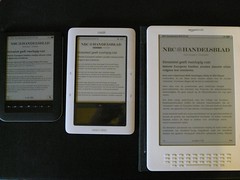
PROmedia eBook Reader
PROmedia eBook Reader (Photo credit: PiAir (Old Skool))
Pierre Tristam at FlaglerLive (Flagler County, FL) writes about new EdTech software from CourseSmart that allows teachers to see how much of the reading a student has done. Setting aside pedagogy and the old tradition of fooling the prof, Tristam argues about the nature of reading:

Reading is one of the few truly private activities left us, depending entirely on the isolation created between book and reader, and the way the reader chooses to engage with that book:  reading a page over five times, skipping five pages, underlining five lines, cursing at five others. It’s all between the reader and the book, an act that shares some of the intimacies of sex (and passion) down to its exhilarations and disappointments (a bad writer having a lot in common with a lousy lover). Reading a textbook may not rate in the same category. But it’s no less intimate. The act of reading a textbook still belongs exclusively to the reader. How you read a textbook is irrelevant. If you’re performing well in class, that’s all that should matter.

Amazon has been spying on its readers for some time now
Enhanced by Zemanta

Thursday, July 22, 2010

Peter Osnos on Google Editions at the Atlantic's blogs

What Is Google Editions? - Culture - The Atlantic
Peter Osnos on Google Editions:
Assuming the program works as planned, Google Editions will put up for sale a vast universe of trade e-books, plus technical and professional titles and out of copyright works (which will be free) for use when, where and how the consumer chooses. The consumer will put the books they buy on Google's cloud (which means its enormous servers) and can access their personal library at will. Suppose you start reading on your iPhone and switch to your tablet or desktop—the book will pick up where you left off.

There's also Alex Wilhelm's panic-stricken article at TheNextweb.com: How Google Plans To Crush The E-Book Market


Enhanced by Zemanta

Thursday, May 6, 2010

The iPad and Publishers (New Yorker)

[I had meant to post this link when this article appeared in April....  PWR]

The New Yorker on the iPad and books:

The industry’s great hope was that the iPad would bring electronic books to the masses—and help make them profitable. E-books are booming. Although they account for only an estimated three to five per cent of the market, their sales increased a hundred and seventy-seven per cent in 2009, and it was projected that they would eventually account for between twenty-five and fifty per cent of all books sold. But publishers were concerned that lower prices would decimate their profits. Amazon had been buying many e-books from publishers for about thirteen dollars and selling them for $9.99, taking a loss on each book in order to gain market share and encourage sales of its electronic reading device, the Kindle. By the end of last year, Amazon accounted for an estimated eighty per cent of all electronic-book sales, and $9.99 seemed to be established as the price of an e-book. Publishers were panicked. David Young, the chairman and C.E.O. of Hachette Book Group USA, said, “The big concern—and it’s a massive concern—is the $9.99 pricing point. If it’s allowed to take hold in the consumer’s mind that a book is worth ten bucks, to my mind it’s game over for this business.”
At the Yerba Buena Center, it took a while for Jobs to mention books, and when he did he said that “Amazon has done a great job” with its Kindle. “We’re going to stand on their shoulders and go a little bit farther.” It would probably have been more accurate to say that Jobs planned to stand on Amazon’s neck and press down hard, with publishers applauding. The decision to enter publishing was a reversal for Jobs, who two years ago said that the book business was unsalvageable. “It doesn’t matter how good or bad the product is, the fact is that people don’t read anymore,” he said. “Forty per cent of the people in the U.S. read one book or less last year.” But if reading books was low on the list of things that the iPad could do, it was nonetheless on the list, which meant that Amazon had become a competitor. “There’s a lot of heat between Apple and Amazon and Google,” an adviser to Jobs said. “Steve expresses contempt for everyone—unless he’s controlling them.” An Apple insider said, “He thinks Amazon is stupid, and made a terrible mistake insisting that books should be priced at $9.99.”

The next day, a Friday, John Sargent, the C.E.O. of Macmillan, a publishing conglomerate that includes Farrar, Straus & Giroux and St. Martin’s Press, flew from New York to Seattle to meet with Amazon. Macmillan is the smallest of the big-six publishers, which produce sixty per cent of all books sold in the U.S. Like its peers, Macmillan relies heavily on Amazon, which sells about fourteen per cent of its trade books and the vast majority of its e-books. But Sargent was determined to force Amazon to change the way it does business.
Traditionally, publishers have sold books to stores, with the wholesale price for hardcovers set at fifty per cent of the cover price. Authors are paid royalties at a rate of about fifteen per cent of the cover price. A simplified version of a publisher’s costs might run as follows. On a new, twenty-six-dollar hardcover, the publisher typically receives thirteen dollars. Authors are paid royalties at a rate of about fifteen per cent of the cover price; this accounts for $3.90. Perhaps $1.80 goes to the costs of paper, printing, and binding, a dollar to marketing, and $1.70 to distribution. The remaining $4.60 must pay for rent, editors, a sales force, and any write-offs of unearned author advances. Bookstores return about thirty-five per cent of the hardcovers they buy, and publishers write off the cost of producing those books. Profit margins are slim .*
Though this situation is less than ideal, it has persisted, more or less unchanged, for decades. E-books called the whole system into question. If there was no physical book, what would determine the price? Most publishers agreed, with some uncertainty, to give authors a royalty of twenty-five per cent, and began a long series of negotiations with Amazon over pricing. For months before Sargent’s visit, the publishers had talked about imposing an “agency model” for e-books. Under such a model, the publisher would be considered the seller, and an online vender like Amazon would act as an “agent,” in exchange for a thirty-per-cent fee. Yet none of the publishers seemed to think that they could act alone, and if they presented a unified demand to Amazon they risked being charged with price-fixing and collusion.
In Seattle, Sargent met with Russ Grandinetti, the vice-president in charge of Kindle Content, and told him that if Amazon would not accept the agency model Macmillan would restrict the publication of its e-books. Sargent was giving an ultimatum: Amazon had built its business on comprehensiveness, and if Macmillan withdrew its books it could no longer claim to be the world’s best-stocked bookstore.
Amazon did not react as Sargent had hoped. Before he stepped off the plane, back in New York, that Friday evening, it had stopped selling all of Macmillan’s titles. But, as Jobs hinted, four other major publishers—Simon & Schuster, HarperCollins, Penguin, and Hachette—were quietly planning to follow Sargent’s lead. On Sunday afternoon, Amazon reversed course and announced on its Web site, “We will have to capitulate and accept Macmillan’s terms because Macmillan has a monopoly over their own titles, and we will want to offer them to you even at prices we believe are needlessly high for e-books.”


Reblog this post [with Zemanta]

Wednesday, May 5, 2010

Google Editions to premiere this Summer

The Wall Street Journal had the main story which most bloggers played off, with these interesting details:
While Mr. Palma didn't go into details, users of Google Editions would be able to read books from a web browser—meaning that the type of e-reader device wouldn't matter. The company also could build software to optimize reading on certain devices like an iPhone or iPad but hasn't announced any specific plans.

By contrast, Amazon's digital book business is largely focused on its Kindle e-reader and Kindle software that runs on some other hardware.
[....]

Publishers have yet to publicly commit to participate in the service but Google isn't expected to run into much trouble getting them to join. Publishers tend to believe the more outlets to sell books the better. Even the smallest independent bookstore will have access to a sophisticated electronic-book sales service with a vast selection of titles.
Google it is thought will allow publishers to set their own prices. Among the more interesting comments, came from Ian Paul at ComputerWorld:

One point I haven't been able to confirm: The Journal reported that the e-books would be readable in Web browsers. That's great, because it makes the e-books device independent. On the other hand: Will you be able to bookmark your place and come back to it later, after you've closed the Web page and re-opened it? Will you be able to download e-books for offline reading? You can do both of those things with the Amazon Kindle and Apple iBooks.
Will the e-books be available in a standard format so the buyer can have some assurance he'll be able to read them in years or even decades? Google says its e-book strategy includes an electronic bookshelf for the books you access through Google, "so you can come back and access [them] whenever you want in the future." Is that true? Or would it be more accurate to add the clause, "as long as Google continues to offer the service." This is important because books have a long shelf life (so to speak). I'm willing to put up with Digital Rights Management in video and music because I figure I'm only interested in hanging onto that content for a couple of years at most; but I've had my favorite books for nearly 40 years, and I hope to hang onto them for at least 40 more. Will I be able to say the same for e-books?
Other questions: How will payment-processing be handled? How will Google generate revenue off this? How will Google split revenue with publishers? Will authors and small publishers be able to self-publish books on Google Editions?
Finally, and this is huge: Will Google screen content, as Apple does, or will Google treat its customers like grownups who can decide for themselves what ideas they and their children should be exposed to?
Update 5/6/2010; Library Journal chimes in, reporting on "the search giant’s “cloud bookstore” of titles available on any device" and further reports on Chris Palma's talk at a conference held at Random House.

(h/t for the WSJ article to Jeremy Dibell at Philobiblos)


Reblog this post [with Zemanta]

Wednesday, March 3, 2010

Amazon and trade book pricing

It looks like Macmillan and Amazon have finally agreed to publisher pricing. Links from a Library Journal article to blog notices about the agreement. "No more "windowing" of bestsellers; $9.99 prices, but not for bestsellers."

Macmillan CEO Explains "Agency Model" for Selling Ebooks - 3/3/2010 - Library Journal